The basics
What is a static caravan?
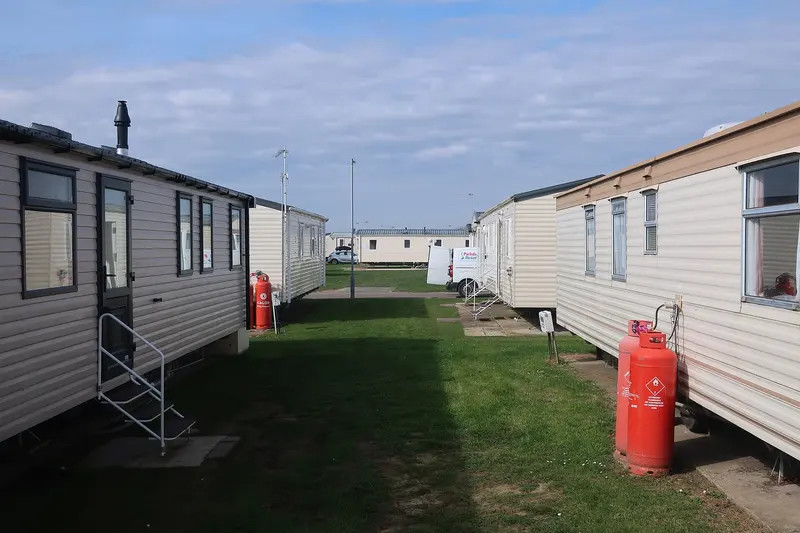
A static caravan is a caravan kept on a pitch at a holiday park and used for holidays. Here is what the law counts as a caravan, and how a static differs from a holiday lodge, a residential park home and a touring caravan.
On this page
At a glance
- In law a caravan is any structure designed or adapted for living in that can be moved from place to place — by towing, or carried on a vehicle or trailer.
- A twin unit (two sections joined on site) still counts as a caravan up to 20 m long, 6.8 m wide and 3.05 m high inside.
- Holiday static caravans are usually built to BS EN 1647; residential park homes, and many holiday lodges, to BS 3632.
- A static caravan on a holiday park is for holidays only — it can’t be your home.
The short answer
A static caravan — the industry often calls it a “caravan holiday home” — is a caravan that is kept on a pitch at a holiday park instead of being towed from place to place. You use it for holidays and leisure. It is too big to tow behind a car, so it is moved by specialist transport.
What the law counts as a caravan
In Great Britain the definition is in section 29 of the Caravan Sites and Control of Development Act 1960. A caravan is any structure designed or adapted for people to live in that can be moved from one place to another, either by being towed or by being carried on a motor vehicle or trailer. Motor vehicles adapted for living in count too. Tents don’t, and nor do railway carriages standing on a working railway.
The Caravan Sites Act 1968 (section 13) extended this to twin units. A unit made of no more than two separately built sections, bolted or clamped together on site, is still a caravan as long as — once put together — it could physically be moved by road, towed or carried. It doesn’t stop being a caravan just because it would be unlawful to move it on a road in one piece. The size limits are:
| Twin-unit limit | Maximum |
|---|---|
| Length (not counting the drawbar) | 20 m |
| Width | 6.8 m |
| Internal height of the living space (lowest floor to highest ceiling) | 3.05 m |
These replaced the old limits of 60 ft × 20 ft × 10 ft — in England on 1 October 2006, in Wales on 30 November 2007 and in Scotland on 15 November 2019. Northern Ireland’s definition, in section 15 of the Caravans Act (Northern Ireland) 2011, uses the same wording and the same limits.
Anything larger, or made of more than two sections, is likely to be treated as a building rather than a caravan. That changes how planning, VAT and council tax or rates work — HMRC’s VAT guidance points out that a structure that fails the caravan test may be a building for planning purposes.
Static caravan, lodge, park home or tourer?
| What it is | Usually built to | |
|---|---|---|
| Static caravan (caravan holiday home) | A caravan sited permanently on a pitch at a holiday park and used for holidays and leisure only | BS EN 1647 |
| Holiday lodge | Usually a unit built to the residential park home standard, but sold and marketed for holiday use only | BS 3632 |
| Residential park home (mobile home) | A caravan that is someone’s only or main home, on a site licensed for people to live in all year | BS 3632 |
| Touring caravan | A caravan towed on the road behind a car | — |
Three things worth knowing:
- A lodge is still a caravan in law if it fits within the twin-unit limits. What you can do with it depends on the park’s planning permission and site licence, not on what the brochure calls it. The National Caravan Council (NCC) notes that some BS 3632 units are also marketed as holiday caravans.
- Park homes are treated differently. Their residents have rights under the Mobile Homes Act 1983 (in Northern Ireland, the Caravans Act (NI) 2011). The NCC stresses that the park home laws don’t apply to holiday caravans or lodges on holiday parks. See holiday home or residential park home?
- Tourers are limited by the towing rules. On roads in Great Britain a trailer can be no wider than 2.55 m, and a vehicle with a maximum authorised mass of 3,500 kg or less can’t tow a trailer longer than 7 m. Static caravans are bigger than that. HMRC uses the same two measurements to decide the VAT rate on a caravan — see VAT on static caravans.
BS EN 1647 and BS 3632: why the build standard matters
BS EN 1647 is the standard for caravan holiday homes. It sets health and safety requirements for caravans used as temporary or seasonal accommodation, including how much snow load they can withstand, their structural stability and what the owner’s handbook must contain.
BS 3632 is the British Standard for residential park homes — homes designed for people to live in permanently. The current edition, BS 3632:2023, was published in September 2023.
The NCC explains that BS 3632 units usually have higher levels of insulation, and that not every holiday caravan is designed to be used in winter. If you plan to use yours in the colder months, ask whether it has a “winter pack”, and look for the NCC energy efficiency rating label: a score from 0 to 10 (10 is best) shown in the front window of approved holiday caravans.
The build standard also decides the VAT on a new caravan — see VAT on static caravans.
What the NCC Approved badge means
Under the NCC’s Manufacturers’ Approval Scheme, inspectors check holiday caravan models at the factory against BS EN 1647 — up to 500 checks on a unit. A manufacturer has to pass three formal inspections in a row and then faces unannounced visits. The badge means that type of caravan was independently inspected at the factory.
Sources
Checked 6 October 2026. We wrote this guide from these sources, in our own words:
- Caravan Sites and Control of Development Act 1960, section 29 (legislation.gov.uk)
- Caravan Sites Act 1968, section 13 (twin-unit caravans) (legislation.gov.uk)
- SI 2006/2374 (England): twin-unit size change (legislation.gov.uk)
- SSI 2019/295 (Scotland): twin-unit size change (legislation.gov.uk)
- Caravans Act (Northern Ireland) 2011 (legislation.gov.uk)
- HMRC VAT Notice 701/20: caravans and houseboats (gov.uk)
- GOV.UK: towing weight and width limits (gov.uk)
- NCC Best Practice Guidance for Holiday Parks (February 2025) (thencc.org.uk)
- NCC: Making the best use of your holiday caravan (2025) (thencc.org.uk)
- Caravan Sites Act 1968, section 1 (protected sites) (legislation.gov.uk)
- Mobile Homes Act 1983, section 1 (legislation.gov.uk)
- BSI: BS 3632 Residential park homes (knowledge.bsigroup.com)
- BSI: BS EN 1647 Caravan holiday homes (knowledge.bsigroup.com)
- NCC Energy Efficiency Rating Scheme (thencc.org.uk)
- NCC Manufacturers’ Approval Scheme (thencc.org.uk)
Travel Trailers is an independent guide. It is not owned by, or connected to, any holiday park operator, caravan manufacturer, dealer or trade body. Spotted something out of date? Tell us.